Flow of Accounting Information
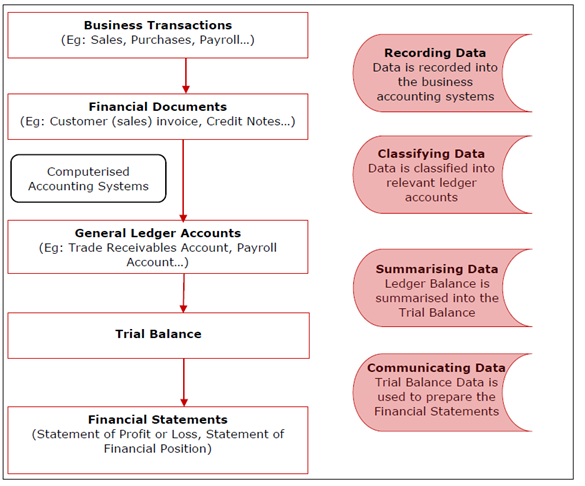
The eventual goal of accounting is to present fairly and accurately all financial transactions in the financial statements.
The process starts with recording all business transactions with information available in the financial documents and classifying them into the relevant ledger accounts through computerised systems or journals. At year-end, balances of each ledger account form the trial balance, which is used as a basis to prepare the financial statements.
Information from business transactions travels through the accounting system, which eventually forms the financial statement.
|
Exam advice |
|
The FA/FFA exam will assume the use of computerised accounting systems, as follows: · Sales and purchases modules will be integrated into the accounting system. This means that any sales invoices produced within the sales module will automatically be recognised in the individual customer’s account (in the receivables ledger) and the trade receivables, and sales, general ledger accounts; and purchase invoices entered into the purchases module will be automatically posted to the individual supplier’s account (in the payables ledger) and the trade payables, and other relevant general ledger accounts (see section 4.1.1). · The term ‘sales module’ or ‘sales system’ may be used. Equally the term ‘purchase module’ or ‘purchase system’ may be used. · It will be assumed that manual journal entries would be required to the general ledger in respect of acquisitions and disposals of non-current assets. · Recording of bank and cash transactions will also be by manual journal entries for both cash purchases and sales, payments to suppliers and receipts from customers. · Payroll is a manual process, meaning that a journal entry will need to be manually entered into the general ledger weekly or monthly in respect of wages and salaries. · Inventory systems may be manual or integrated. If they are integrated, then it is assumed that inventory levels are automatically checked before sales or purchase orders are made, and inventory movements inwards will be updated automatically to the general ledger purchases accounts. However, manual journal entries would be required in both manual and integrated inventory systems to transfer purchases to cost of sales and to record opening and closing inventory in the cost of sales. · Filing and archiving will be held electronically. |
- Business Transactions
Business transactions are the day-to-day activities of the business that have a monetary value. For a business to operate, it needs to generate income by making sales and incur expenses such as purchases and overheads.
- Financial or Source Documents
A financial document is produced for each business transaction to record information about individual transactions.
Sales, purchases, cash payments and receipts are business transactions. Their corresponding documents are the customer (sales) invoice, supplier (purchase) invoices, cheque stubs and remittance advice, respectively.
Financial documents in a computerised system may be automatically generated as transactions are processed; controls will be implemented that make the source document’s creation, distribution, and authorisation mandatory before any transaction is recorded.
|
Exam advice |
|
In the FA/FFA exam, the term ‘customer (sales) invoice’ or ‘sales invoice’ may be used. Equally, the term ‘supplier (purchase) invoice’ or ‘purchase invoice’ may be used. |
- General Ledger Accounts
The general ledger contains all the individual ledger accounts used by a business for the purpose of producing the financial statements.
Information from the source documents is classified into their respective ledger accounts using double entries via computerised systems and manual journal entries. The general ledger contains accounts for the assets, liabilities, capital, income and expenses of the business.
For example, where a customer has purchased goods on credit (i.e. will pay later) information on a sales invoice is posted into the trade receivables account and sales account in the general ledger using double entries.
- Trial Balance
At the end of an accounting period, each ledger account is closed off, and the account balance flows to the trial balance. The trial balance is a list of each ledger account’s closing balances. An accountant prepares the trial balance periodically, usually once during year-end.
If the information entered into the ledgers conforms to the fundamental principle of double-entry, the trial balance should have equal debit and credit balances. The trial balance is investigated to ensure no errors have occurred in recording the transactions.
- Financial Statements
Each ledger account balance in the trial balance is totalled and summarised into financial statement categories: assets, liabilities, capital, income or expenses.
The statement of financial position provides an overview of a business’s assets, liabilities, and capital at the financial year-end.
The statement of profit or loss summarises a business’s income and expenses during the financial year. The profit or loss is the net of the business’s income and expenses.
- Detailed customer and supplier balances
In integrated systems, detailed customer and supplier account balances can be produced by the sales and purchases modules. These typically show all outstanding invoices and may also show earlier invoices matched to payment transactions.
The total of all the customer balances (in the receivables ledger) should be the same as the total in the trade receivables balance in the general ledger. Similarly, the totals of all the supplier balances (in the payables ledger) should be the same as the payables account in the general ledger. Sometimes the totals in the detailed reports may not equal the balances in the general ledger, and if this is the case, it will be necessary to find the reasons for the differences.
The individual customer and supplier accounts are not in the general ledger, and do not form part of the double-entry system. However, if there is an assumption that the sales and purchase modules are integrated with the general ledger, then all invoices and credit notes should automatically be posted to the individual customer and supplier accounts, so the only reason for any difference would relate to payments, as these are updated manually to both the general ledger accounts, and the individual customer/supplier accounts. It is therefore possible that payments could be omitted (e.g. posted in the general ledger but not to the individual customer/supplier accounts, or vice versa).
Types of Business Transactions
Business transactions are the day-to-day activities of the business that have monetary value and are recorded in the accounting records.
The main types of business transactions are:
- Sales
Sales are the exchange of goods or services for money. These may be for cash or credit. Cash sales are made in exchange for immediate cash payment, while credit sales are made with a promise of payment to the business in the future.
- Sale Returns
Sales returns are faulty or incorrect goods returned by a customer due to faulty or damaged goods being supplied. The value of sales returns is netted off against sales.
- Purchases
Purchases are the exchange of money for goods or services. Cash purchases are made in exchange for an immediate cash payment, while credit purchases are made with a promise to pay the supplier in the future.
- Purchase Returns
Purchase returns are faulty or incorrect goods sent back to the supplier due to faulty or damaged goods being supplied. The value of purchase returns is netted off against purchases, or against the relevant expense or asset account that was debited when the purchase was originally entered into the system.
- Payments
Payments are the settlement or transfer of money to a third party.
- Receipts
Receipts are due to the business receiving money from a third party.
All financial transactions must have a valid financial document with details of the transaction. For example, a sales transaction is recorded using an invoice.
Activity 1
Determine whether the statement is True or False.
- An example of a credit purchase would be when the business pays the supplier on the delivery of the goods.
- An example of a cash sale would be when the business delivers goods to the customer and is paid immediately.
- Sums of money paid to a supplier in exchange for the receipt of goods are called ‘payments’.
- Goods delivered to a customer but then returned to the supplier would be sales returns for the supplier.
Types of Financial Documentation
Bookkeepers record business transactions based on supporting financial documentation. Financial documents (or source documents) provide evidence of the existence of financial transactions.
- Quotationis a document sent by the seller with details of the price for each item. The quotation highlights the quantity, description and price of the purchase required.
- Purchase Orderis a document completed by the customer and sent to the supplier, highlighting the items they want to order.
The purchase order contains the supplier’s name and address, a unique reference number, the quantity and the description of the purchase. The business may also include its terms and conditions regarding payment and the person responsible for placing the order.
- Sales Orderis an internal document generated to process a customer order after receiving it. It essentially translates the format of the purchase order received to the format used by the business (seller).
The sales order contains the customer’s name and address, the quantity and descriptions of the required products. There may also be notes specific to the order, including terms specified by the customer.
- Delivery Note or Goods Dispatched Noteis a document that accompanies the delivered goods. The customer signs the delivery note to confirm proof of delivery when the goods are delivered. The supplier also checks that the correct goods are being sent.
The goods dispatched note contains the business’s name, address, quantity and description of goods being delivered.
- Goods Received Note (GRN)is an internal document completed by the customer to ensure everything ordered has been received. The GRN lists the quantity and description of the goods received.
- Customer (sales) invoiceis a document sent to customers with details of the items sold to the customer on credit. Details include the date, quantity, price, and parties involved.
A sales invoice contains the seller’s and buyer’s name and address, as well as the quantity, price, total value and sales tax on the sale. The seller’s payment terms will also be stated.
- Supplier (purchase) invoiceis a document received from suppliers with details of the items purchased on credit. Details include the date, quantity, price, and parties involved.
- A purchase invoice contains the seller’s and buyer’s name and address, as well as the quantity, price, total value and sales tax on the sale. The seller’s payment terms will also be stated.
- Credit Noteis a document issued by the supplier to reduce the value of the previously issued invoice due to faulty or damaged goods being supplied.
A credit note contains the supplier’s and customer’s name and address, as well as the quantity, price, total value and sales tax on the returned sale.
- Debit Noteis a document issued by the customer to the supplier to request a credit note.
The debit note contains the customer’s and supplier’s name and address, the details of the goods returned (quantity, price, total value and sales tax) and the reason for the return.
- Statement of Accountis a document sent by a supplier to a customer with details of all transactions between the parties. The statement also highlights the balance owed to the supplier at the end of the month.
A statement of account contains the seller’s and customer’s name and address, invoice numbers, outstanding amounts, and payments received. Credit note numbers and values would also be included.
The statement of account’s primary purpose is to support reconciliation of the supplier’s account. Supplier statement reconciliations are discussed in Chapter 6.
- Remittance Adviceis a document sent to the supplier to show that payment has been made.
The remittance advice contains the method of payment, such as an enclosed cheque or a direct bank transfer, and details of the invoices covered.
- Receiptis a document issued by the business to the customer to confirm that a payment has been received that pays any outstanding invoices.
A receipt contains the business’s and customer’s name and address, the amount paid by the customer and a list of the invoice numbers that have been paid.
|
Key Point |
|
Source documentation can be created and issued electronically through automated processes, with the necessary fields populated from the accounting system’s databases. |
Activity 2
Katrod Co is a business that sells shoes directly to customers. It has some shoes which customers can personalise, so there is no standard list price. Sales documentation is essential as it allows Katrod Co to have accurate financial records about the volume and value of its sales.
Match each financial document below with its associated activity.
Documents:
- Purchase order
- Goods despatched note
- Receipt
- Customer statement
- Quotation
- Credit note
- Customer (sales) invoice
Activity:
Katrod Co sends this to a customer who has unpaid invoices.
Katrod Co’s customer sends this as confirmation of the intended purchase.
Katrod Co sends this to a customer. It provides a fixed price for the sale of some personalised shoes.
Katrod Co issued this to the customer when she returned a pair of shoes.
Katrod Co issues this to the customer to confirm that their payment has been received.
Katrod Co issues this to the customer after delivery confirmation; It requests payment.
Katrod Co sends this to its customer with a delivery; It states there are three pairs of trainers.
Activity 3
Katrod Co needs to buy components and materials from its suppliers. It is essential that its data and documentation are updated, or it will not be able to make its shoes on time.
Match the purchase activity to the correct financial document.
|
Purchase Activity |
Financial Document |
|
|
Katrod Co sent this document to its supplier when paying the outstanding invoices at the end of the month. |
Supplier (Purchase) Invoice |
|
|
Katrod Co sent this document to its supplier to request a purchase of a batch of shoelaces. |
Purchase Order |
|
|
Katrod Co’s supplier issues this document requesting payment as soon as the delivery of the shoelaces has been confirmed. |
Goods Received Note |
|
|
Katrod Co’s supplier issues this document if the shoelaces are returned to the supplier. |
Remittance Advice |
|
|
Katrod Co’s warehouse produces this document upon receipt of the shoelaces to check against the original order. |
Credit Note |
Purpose of General Ledger Accounts
Most users of financial statements do not require the detail of every transaction that large businesses will encounter daily. Therefore, the financial information for each transaction is entered in the general ledger accounts before being summarised and presented in the financial statements.
Financial information from the source document is posted to the relevant ledger accounts either automatically or through manual journal entry using the fundamental principle of double-entry (see ‘The Journal’ later in this chapter).
The general ledger contains individual accounts for the assets, liabilities, capital, income and expenses of the business. For example, where a customer has purchased goods on credit (i.e. will pay later) information on a customer (sales) invoice is posted into the trade receivables ledger account and sales ledger account in the general ledger.
The general ledger contains all the individual ledger accounts used by a business.
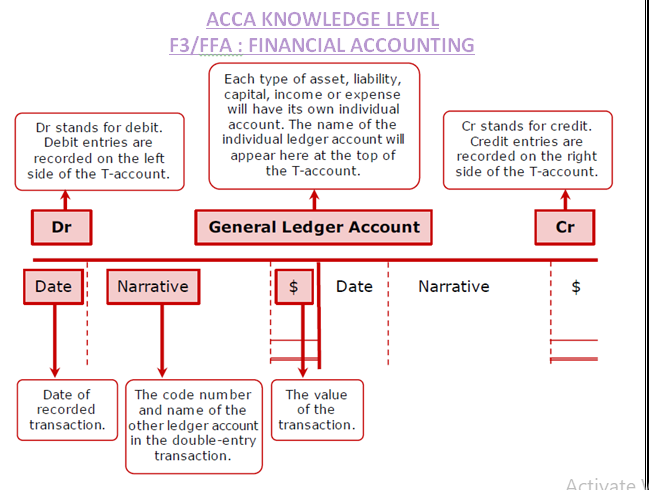
T-Accounts
The individual ledger accounts within the general ledger are called T-accounts, as they form the shape of a ‘T’, as shown below:
Main General Ledger Accounts
Statement Of Financial Position Accounts
Statement of financial position accounts are those used for recording assets, liabilities and capital transactions. These accounts are included in the statement of financial position:
Examples of statement of financial position ledger accounts are:
- Trade receivables– This asset ledger account records sales made where the settlement has not been received. A debit entry into the trade receivables ledger account increases its balance.
Credit sales increase the trade receivables balance, while payment received from credit customers reduces its balance.
- Cash/Bank– This asset ledger account records the cash movements of the business. A debit entry into the cash/bank ledger account increases its balance.
Receipts from customers increase the cash/bank balance, while payments to suppliers or expenses reduce its balance.
- Trade payables– This liability account records purchases of goods and services for resale that have been incurred but not yet paid. A credit entry into the trade payables ledger account increases its balance.
Credit purchases increase the trade payables balance, while payment to credit suppliers reduces its balance.
|
Asset and liability a/c |
|
|
A DEBIT entry represents |
A CREDIT entry represents |
|
1 an INCREASE in a ASSET; or |
1 an INCREASE in a LIABILITY; or |
|
2 a DECREASE in a LIABILITY. |
2 a DECREASE in an ASSET. |
Income and Expenditure Accounts
Income and expenditure (expense) accounts record the transactions determining profit (or loss) for a period.
Examples of income and expenditure ledger accounts are:
- Sales– This income ledger account records the cash or credit sales of the business. A credit entry into the sales ledger account increases its balance.
Sales generated by the business increase the sales balance. A sales return transaction reduces the sales ledger account balance if no separate sales return ledger account is maintained.
- Expenses– The expense ledger accounts record the purchases and other expenses of the business. A debit entry into an expense ledger account increases its balance.
Purchases incurred by the business increases the purchases ledger account. A purchase return transaction reduces the purchases ledger account balance if no separate purchase returns ledger account is maintained.
|
Income and expenditure a/c |
|
|
A DEBIT entry represents |
A CREDIT entry represents |
|
1 an INCREASE in EXPENSE; or |
1 an INCREASE in a INCOME; or |
|
2 a DECREASE in a INCOME. |
2 a DECREASE in an EXPENSE. |
Balancing Off Ledger Accounts
Balancing the accounts is the first step in ensuring that the double entries have been recorded correctly.
- To balance an account means to put in a balancing figure (balance c/d)
- Accounts can be balanced at any time, generally at every month’s end.
|
Key Point |
|
General ledger accounts will always be balanced before they are closed at the end of a reporting period when the financial statements will be drawn up. |
Steps to Close off Ledger Account
Balancing off ledger accounts is applied systematically to every account.
- Sum the debit side and note the total. Sum the credit side and note the total.
- Whichever is the larger will be the total on both sides.
- Insert the balancing figure so that both sides are equal (balance c/d)
- If the sum of the debits exceeds the sum of the credits, the balancing figure is a debit balance. This is brought down (b/d) on the account’s debit side.
If the sum of the credits exceeds the sum of the debits, the balancing figure is a credit balance. This is brought down (b/d) on the credit side of the account.
|
Example 1 |
||||||||||||||||||||||||||||||||||||||||||||||||
|
The below T-Account is Manisha’s Bank account in the general ledger for the year ended 31st December 20X6: her first year of trading. Manisha has posted cash receipts and payment entries into the Bank ledger account as shown and is now closing her accounts.
To close the Bank ledger account, the following steps are made: 1. Sum the debit and credit sides: Total Debits = $300 + $800 + $400 + $500 = $2,000 Total Credits = $220 + $160 + $720 + $80 = $1,180 2. Since the debit side is higher than the credit, the total to be included in the ledger is $2,000. 3. Insert the balancing figure so that the sum balances. 4. Since the sum of the debit side is larger than the credit, the balance c/d will be brought down as the opening amount on the debit side for the following period. In this case, Manisha has a closing bank balance of DR $820 which will show on the debit side of the Bank ledger in the following financial period. |
||||||||||||||||||||||||||||||||||||||||||||||||
Application of Ledger Close-off
Ledger accounts that contain balances used in the preparation of the statement of financial position are treated differently from those ledger accounts used for the statement of profit or loss.
- Statement of financial position ledger accounts
These are asset, liability and capital accounts. The closing balances for this year are the opening balances for next year. The ledger accounts show balances carried down and brought down, as seen for the bank ledger account in the earlier example.
- Statement of profit or loss ledger accounts
These are income and expense accounts. Profit is calculated as income minus expenses and becomes part of capital at the year’s end.
The ledger accounts will reference the statement of profit or loss instead of the balance carried down. There is no brought-down balance because the balances will all be transferred to the profit or loss ledger account at the year’s end. The profit or loss ledger account is created at year-end and is transferred to the capital section of the statement of financial position.
Activity 4
Match the example of the overall balance of a specific ledger account to the possible explanation of the general ledger account’s name and its debit and credit balance.
|
Overall Balance |
Explanation |
|
|
Balance b/d $9,810 (an overdraft) |
Wages expense account. Total debits $25,800 and total credits $1,000 |
|
|
Balance b/d debit $34,900 |
Bank account. Total debits $47,570 and total credits $57,380 |
|
|
Profit or loss debit $24,800 |
Trade receivables account. Total credits $47,570 and total debits $57,380 |
|
|
Profit or loss credit $34,900 |
Trade payables account. Total credits $25,800 and total debits $1,000 |
|
|
Balance b/d credit $24,800 |
Vehicle account. Total debits $36,900 and total credits $2,000 |
|
|
Balance b/d debit $9,810 |
Sales account. Total credits $36,900 and total debits $2,000 |
Computerised Accounting Systems
Technological advancements make it unlikely that financial transactions are recorded on paper. Instead, business transactions are now recorded using a computerised accounting software system.
Using a computerised system, a bookkeeper may input details of the source document, and an automated double-entry is generated to the relevant ledger accounts.
In a computerised system, activities are categorised into three processes:
- Inputs– Inputs are data entered into the accounting system from the source documents.
- Processing– Data entered is posted into the relevant general ledger accounts
- Output– Financial statements and other reports are produced for management use
Features of a Computerised System
- A typical computerised accounting system comprises several modules to operate different business functionssuch as sales, purchases, inventory, receivables and payables.
- Computerised information can be integratedwith other management modules to update transaction trails. For example,
- Sales invoices generated through the sales module are automatically posted into the receivables or cash ledger accounts. It can also update the inventory system to record its movement and reduce the quantity.
- Purchase invoices are entered into the purchases module, and the relevant ledger accounts, such as the payables, inventory, and any other relevant general ledger accounts, are updated.
- Back-upsof the data in a computerised system are available in the event of lost files.
- Authorisationof transactions by senior personnel is done through PINs, passwords, security tokens or apps. For cloud-based systems, authorisation may be done remotely.
- A computerised system allows you to amend transaction detailsand keep a log of the changes.
- There is a reduced likelihood of errors and omissionsas computer systems do not allow error data to be processed.
- Real-time comprehensive and accurate management reportscan be generated cost-effectively.
-
Examples of output reports from a receivables ledger system include:
- Customer (sales) invoice
- Customer statement
- Trade receivables ageing list
- Sales analysis report
Examples of output reports from a payables ledger system include:
- List of outstanding supplier balance
- Purchases analysis report
Desktop vs Cloud Accounting Systems
A desktop accounting (on-premise) software system is hosted on a computer’s hard drive. The software is initially installed on the business premise’s desktop and is maintained regularly.
A cloud accounting software system is hosted, updated, and maintained online. The organisation pays a fee to a service provider that hosts the software on remote servers.
Desktop Software
Cloud Software
Accessible on the desktop where software is installed
Accessibility
Accessible only with an internet connection
Single access. Only one person can use the software at a time
Users
Multiple users can use the software, even remotely.
Updates and Backup need to be performed manually
Updates and Backup
Automatically updates and backups data to an online server
One-time fee until renewal
Pricing
Monthly subscription fee
Needs installation
Installation
No installation required
Security tied to the desktop. Data can be lost if the computer crashes or breaks down.
Security
Security depends on the cloud software system, usually with multiple layers of encryption.
-
Sources of Information
The accounting system will draw information from several sources to facilitate processing:
Source
Description
Example
Manual data entry
A human keys transactional information into the system, usually through a terminal.
Hardware input devices such as scanners or barcode readers may support this.
· A cashier inputs customer purchases with a bar code scanner, then captures payment information with a point-of-sale payment device that reads the customer’s credit card.
· A clerk keys in the details of an invoice into the accounting system at a terminal for processing.
Computer-assisted data entry
An automated system reads an input source and updates the necessary fields in the accounting system data entry.
This process may be assisted by robotic process automation and AI that can identify and read documents and other input.
· The accounting system automatically reads emails and attached documents received from customers from its purchasing email address and automatically populates the fields for a sales order to be authorised.
· A robot automatically scans, detects, and records RFID tags attached to inventory to update inventory records automatically.
Databases
Files that store large amounts of data.
It may contain customer and supplier master data and transaction history.
· The system will automatically query approved supplier data to populate the necessary fields for a requested purchase order.
· The system will collate and aggregate a customer’s transaction history to process a request for the customer’s statement for outstanding trade receivables.
Integrated systems
Accounting systems may be integrated with the systems of suppliers and customers to facilitate the fast processing of orders.
· When a customer’s supply of material runs low, an automatic purchase order is sent to the business’s accounting system, verifying the order and creating a sales order and despatch note automatically.
The Journal
Automatic Transaction Processing
As explained in section 4.1.1, in integrated systems, most routine transactions are posted automatically by the relevant modules. For example, when a customer (sales) invoice is generated in the sales module to record a credit sale, a transaction will be automatically posted in the general ledger, applying the fundamental principle of doubleentry, as follows:
|
General Ledger Account |
$ |
|
|
Debit |
Trade receivables |
X |
|
Credit |
Sales |
X |
|
Exam advice |
|
In the FA/FFA exam, for transactions which are automatically posted to the general ledger, such as the example above, you may be required to identify the double-entry (i.e. which account is debited and which account is credited, as shown above). Alternatively, you could be asked to prepare a journal entry (see ‘manual journal entries’ below), even though the transaction would be processed automatically. This is to test your understanding of double-entry principles. |
Manual Journal Entries
Where transactions are not posted automatically to the general ledger, they will need to be posted manually and recorded in the journal. The posting of manual transactions is referred to as manual journal entries.
|
Definition |
|
The journal is a record of accounting entries (or journal entries) posted to the general ledger to enter non-routine transactions or correct errors. A journal entry refers to the manual posting of an accounting transaction to the general ledger. |
Journal entries have the following format (for example to record a payment of wages):
|
General Ledger Account |
$ |
|
|
Debit |
Wages |
X |
|
Credit |
Bank |
X |
Journal entries also include a brief explanation e.g. ‘to pay wages’, and the relevant general ledger account codes for the particular accounting system used by the business.
In the FA/FFA exam, as discussed at the start of this chapter, there will be an assumption that the sales and purchases modules are integrated with the general ledger. So transactions related to customer (sales) invoices and credit notes, and supplier (purchase) invoices and credit notes will be posted automatically to the general ledger. It will be assumed that all other transactions will be recorded manually, using journal entries. This includes cash and bank transactions, transactions relating to non-current assets, inventories and accruals and prepayments.
Activity 5
State whether each of the transactions listed below will be reflected in a manual journal entry.
- Goods purchased from a supplier on credit are delivered and the invoice is received
- Rent expense was debited in error to the repair expense ledger account
- Car repair expense was debited in error to the car asset ledger account
- Goods sold to a customer on credit are dispatched and the invoice is issued
.Activity 6
For each of the transactions listed below, record the journal entries to correct the error.
- Rent expense debited in error to repair expense ledger account. The amount concerned is $50.
|
General Ledger Account |
$ |
|
|
Debit |
||
|
Credit |
||
- Car repair expense was debited in error of $60 to the car asset ledger account.
|
General Ledger Account |
$ |
|
|
Debit |
||
|
Credit |
||
|
Exam advice |
|
The exam will often require students to identify the appropriate journal entries for a given narrative. This is explored in subsequent parts of this text. |
Accounting Systems
|
Definition |
|
Accounting system – The records and procedures, both formal and informal, which relate to the assembling, recording, retrieval and reporting of information related to the financial operations and which also provide necessary internal controls. |
A sound accounting system:
- is necessary to ensure resources are allocated efficiently and effectively.
- incorporates policies and procedures, including necessary internal controls, to assist management in achieving organisational objectives.
Useful Accounting Information
Accounting is concerned with the collection, analysis and communication of financial information which users need for decision-making purposes.
For information to be useful, it must possess certain qualities. It must be:
- relevantto the needs of the user
- reliable(complete, accurate and objective)
- completefor the purpose(s) for which it is intended
- accurateso that users have confidence in it
- objective(without bias)
- comparableto make meaningful comparisons
- cost-effective(the cost of preparation does not exceed its value)
- user-friendlyso that it is understandable and clear
- concise(distinguishing important matters and ignoring trivia)
- timelyso that information arrives on time to inform decisions.
Organisational Objectives
Management must ensure, as far as possible:
- Orderly and efficient business conduct, including adherence to management policies
- That assets are safeguarded
- The prevention and detection of fraud and error
- The accuracy and completeness of the accounting records
- Timely preparation of reliable financial information.
Internal controls relating to the accounting system seek to ensure that:
- transactions are authorised and valid
- all transactions and other events are recorded promptly at the correct amount, in the appropriate accounts and the proper period (accurate and complete)
- access to assets and records is restricted
- recorded assets (e.g. in an asset register or perpetual inventory records) are compared with physical assets periodically (and appropriate action is taken regarding any differences).
Policies, Procedures, and Performance
Accounting is concerned with providing useful economic information which will be helpful to those directly (and to some extent indirectly) connected with an organisation.
Although only part of the broader business system, all elements of the business system rely directly (to some degree) on accounting information.
The information provided by the accounting function should:
- Assist management in planning, controlling and decision-making;
- Assist business functions in achieving their objectives;
- Assess the performance of the various areas in an organisation;
- Assess the performance of the managers of the organisation; and
- Enable compliance with various statutory requirements (e.g. Annual financial statements).
Policies
Policies are the principles, rules or guidelines for achieving an organisation’s long-term goals. There are many policies covering areas such as pricing, pay, asset replacement, etc.
Procedures
Procedures are step-by-step activities for completing a task. For example, accounting has procedures for recording sales and purchases.
Performance
Performance concerns outcomes and results – how well or badly actions have been carried out and what the outcomes are.
For example, whether the company’s profits are higher or lower than expected.
Syllabus Coverage
This chapter covers the following Learning Outcomes.
C. The use of double-entry bookkeeping and accounting systems
- Double-entry bookkeeping principles including the maintenance of accounting records
- Identify and explain the function of the main data sources in an accounting system.
- Summarise the contents and purpose of different types of business documentation, including:
-
- Quotation
- Sales order
- Purchase order
- Goods received note
- Goods despatched note
- Customer (sales) invoice
- Supplier (purchase) invoice
- Supplier statement
- Credit note
- Debit note
- Remittance advice
- Receipt
- Describe the key features of a computerised accounting system, including the use of external servers to store data (the cloud).
- Describe how an accounting system contributes to providing useful accounting information and complies with organisational policies and deadlines.
- Identify the main types of business transactions e.g. sales, purchases, payments, receipts.
Syllabus Coverage
This chapter covers the following Learning Outcomes.
C. The use of double-entry bookkeeping and accounting systems
- Double-entry bookkeeping principles including the maintenance of accounting records
- Identify and explain the function of the main data sources in an accounting system.
- Summarise the contents and purpose of different types of business documentation, including:
-
- Quotation
- Sales order
- Purchase order
- Goods received note
- Goods despatched note
- Customer (sales) invoice
- Supplier (purchase) invoice
- Supplier statement
- Credit note
- Debit note
- Remittance advice
- Receipt
- Describe the key features of a computerised accounting system, including the use of external servers to store data (the cloud).
- Describe how an accounting system contributes to providing useful accounting information and complies with organisational policies and deadlines.
- Identify the main types of business transactions e.g. sales, purchases, payments, receipts.
- General ledger accounts and journal entries
- Describe the main types of general ledger accounts, including their nature and function.
- Describe how financial data is initially recorded in the accounting system.
- Explain the use of journal entries and how journal entries are processed to general ledger accounts.
- Identify correct journal entries from given narrative.
- Illustrate how to balance and close the general ledger accounts at the year end.